
|
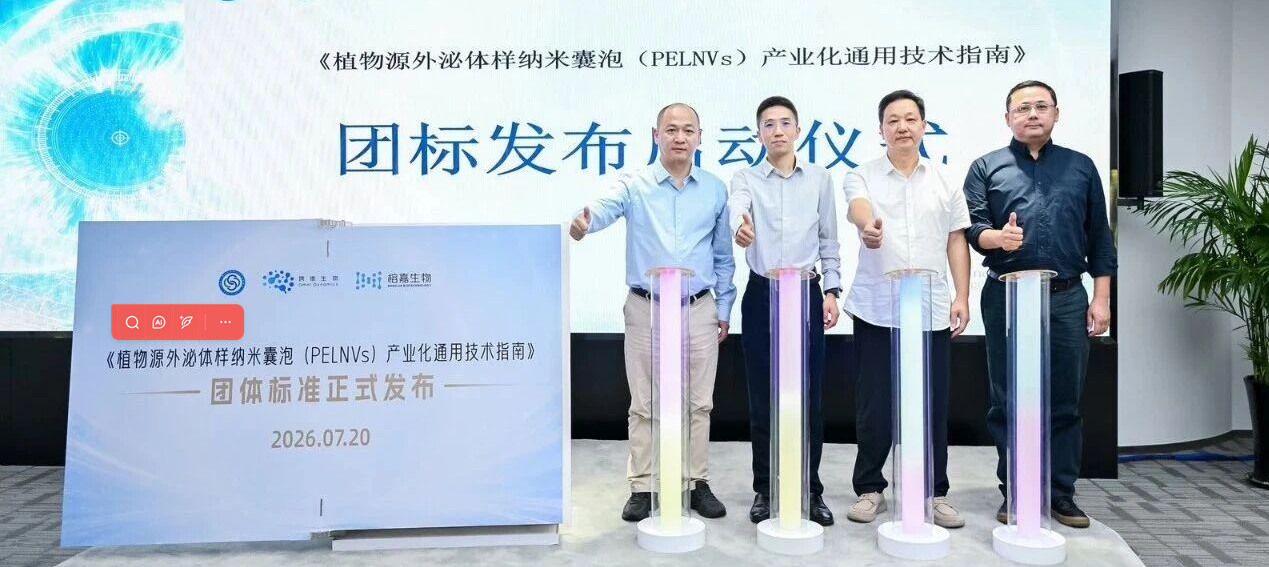
T/SDMDA 003—2026 is China's first industrialization standard for Plant-Derived Exosome-like Nanovesicles (PELNVs), covering food, cosmetics, and medical devices. Released on July 20, 2026 by the Shanghai Yangtze River Delta Medical Device Industry Development Promotion Association (SDMDA), with OmniDynamics (跨维生物科技) as the primary drafter. |
The plant-derived exosome industry has reached a historic turning point. After more than two years of research and validation, OmniDynamics — in collaboration with expert teams from Shanghai Jiao Tong University, Fudan University, and Jiangnan University — has authored the first cross-sector technical specification for PELNVs in China. The standard applies to three regulated verticals: Food, Cosmetics, and Medical Devices.
Plant-Derived Exosome-like Nanovesicles (PELNVs) are natural nanocarriers (30–500 nm) extracted from plant tissues, with growing applications in biomedicine, functional skincare, functional foods, and medical devices. Until now, the field has been held back by three persistent problems:
T/SDMDA 003—2026 resolves all three by defining a single technical language for raw material sourcing, extraction, quality control, stability, and labeling.
What separates T/SDMDA 003—2026 from a purely regulatory document is the depth of the scientific bench standing behind it. The standard was drafted, validated, and defended by principal investigators actively publishing in the PELNV field.
As the first-listed drafter, Dr. Qian led the two-year technical validation program. Under his direction, OmniDynamics built out three core research platforms — genomics, metabolomics, and spatial proteomics — used to fingerprint PELNV raw materials, verify extraction reproducibility, and establish the quantitative thresholds now anchoring the standard.
“A standard with true industrial value cannot remain conceptual. Every quality metric and technical parameter must be built on sufficient experimental data, process validation, and industrial practice.”
— Dr. Qian Xueqing, CEO, OmniDynamics
At the post-release academic forum, Prof. Liu delivered a keynote on the therapeutic frontier of PELNVs, presenting research progress across four high-value directions:
His work directly informs the standard's positioning of PELNVs as functional carriers — reinforcing why concentration (≥10⁹ particles/mL) and purity (≥70%) thresholds matter for real-world efficacy.

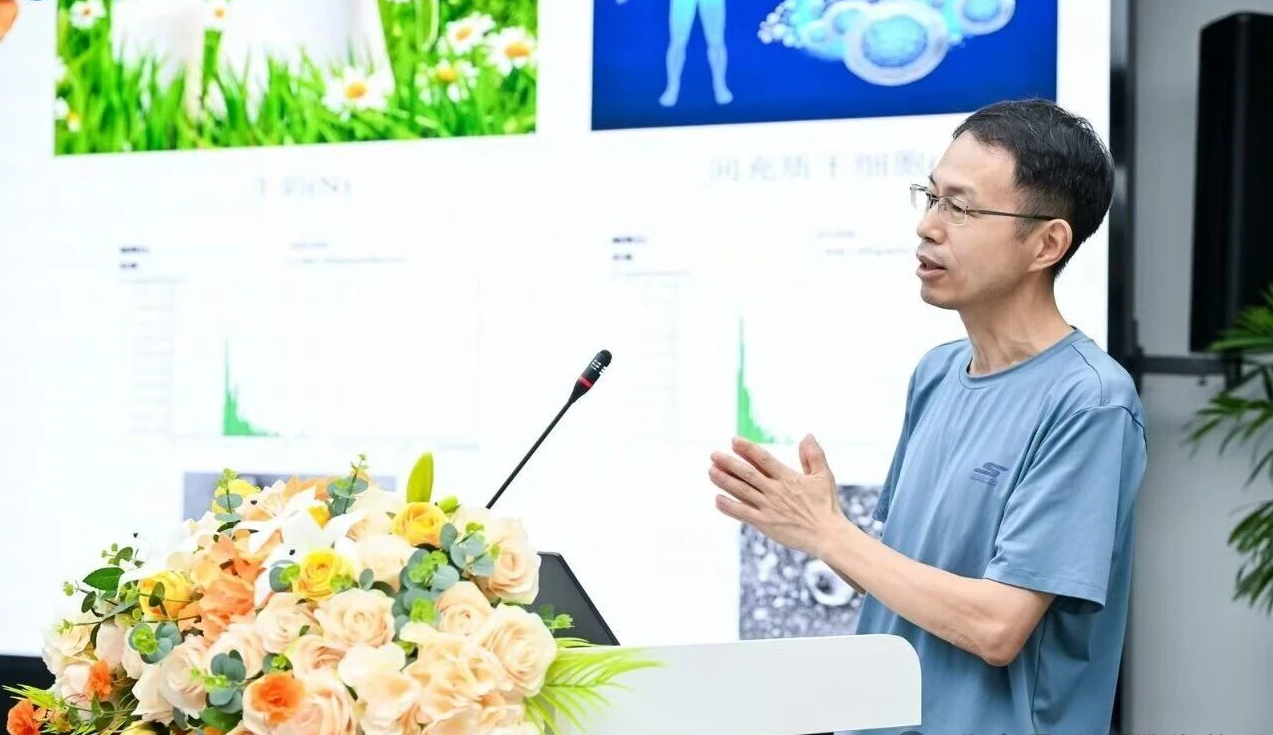
Prof. Ma leads the Developmental Functional Genomics Group at SJTU Bio-X, with a research focus on skin and bone development and the Hedgehog, Wnt, and BMP signaling pathways. At the forum, he presented exploratory research using a psoriasis mouse model comparing natural extracellular vesicles from different botanical sources. His conclusion crystallized the challenge the standard now solves:
“Source, dosage, and quality control are the three core issues that must be addressed for successful industrial translation of plant-derived nanovesicles.”
— Prof. Ma Gang, SJTU Bio-X Institute
His remarks directly justify the standard's mandatory labeling of botanical source, Latin name, plant part used, and testing method.
The urgency of T/SDMDA 003—2026 is amplified by the accelerating publication pace across the PELNV field. Recent peer-reviewed research reinforces both the promise and the fragmentation the standard now addresses:
• Perilla leaf-derived extracellular vesicle-like particles (PLEVPs) have been shown to downregulate psoriasis-associated inflammatory genes via the IL-17, NF-κB, and JAK-STAT pathways (Cao et al., Nanjing University of Chinese Medicine, 2025).
• Mugwort (Artemisia argyi)-derived exosome-like nanovesicles (FAELNs) have demonstrated the ability to modulate gut microbiota and alleviate ulcerative colitis via oral administration (Phytomedicine, 2025).
Without a unified standard, cross-lab and cross-manufacturer comparability collapses. T/SDMDA 003—2026 gives every research group, formulator, and regulator the same technical language.
| Metric | Requirement |
| Particle Size Distribution | 30 nm – 500 nm (median and mean diameter) |
| Purity Threshold | ≥ 70% |
| Particle Concentration | ≥ 10⁹ particles/mL |
| Liquid Product Stability | Storage ≤ −70°C; shelf life ≥ 6 months |
| Lyophilized Product Stability | Storage ≤ 25°C; shelf life ≥ 12 months |
Mandatory labeling — every PELNV product must disclose:
Prohibited claims — non-pharmaceutical products may not claim to treat or prevent disease, or to substitute for medication.
The release ceremony was jointly launched by:
• Wang Minjie (王敏杰) — Deputy Director, Baoshan District Science & Technology Innovation Development Management Commission
• Lin Senyong (林森勇) — Chairman, Shanghai Yangtze River Delta Medical Device Industry Development Promotion Association
• Dr. Qian Xueqing — CEO, OmniDynamics
• Prof. Liu Yun — Shanghai Cancer Institute
“Plant-derived exosome-like nanovesicles are an emerging direction with strong developmental potential in life sciences. This group standard provides an essential foundation for unifying technical language, standardizing quality evaluation, and accelerating translational outcomes.”
— Lin Senyong, Chairman, SDMDA
| If you are a… | The standard helps you… |
| Formulator (cosmetics / food) | Specify PELNV raw materials with objective, verifiable quality parameters |
| Regulator / QA lead | Evaluate supplier claims against a national-level technical benchmark |
| Researcher | Publish and collaborate using a unified nomenclature and testing framework |
| Brand / procurement | Reduce regulatory friction through standardized labeling and documentation |
T/SDMDA 003—2026 is more than a compliance document — it is the industrial infrastructure that PELNVs need to move from lab bench to global shelf. With scientific validation from SJTU, Fudan, and Jiangnan University, clinical translation insights from the Shanghai Cancer Institute, and industrial execution led by OmniDynamics, the standard sets a defensible baseline for quality, safety, and reproducibility across food, cosmetics, and medical devices.
Ready to formulate with standard-compliant PELNVs?
OmniDynamics (跨维生物科技) is a pioneer in bio-nanotechnology, specializing in the identification, extraction, and industrial-scale application of plant-derived exosome-like nanovesicles. Powered by proprietary genomics, metabolomics, and spatial proteomics platforms, we bridge frontier science and regulated commercial application.
2026-07-28
2026-07-27
2025-12-11
Get 5% off your first order.

Request samples, get a formulation brief, and start OEM/ODM co-development.
Request SampleWhether you’re exploring exosome ingredients, OEM/ODM solutions, or private label development, our team is here to support your next step.
Omini Dynamics

